Hydraulic Breaker Types: Silenced vs Side vs Top
Short answer
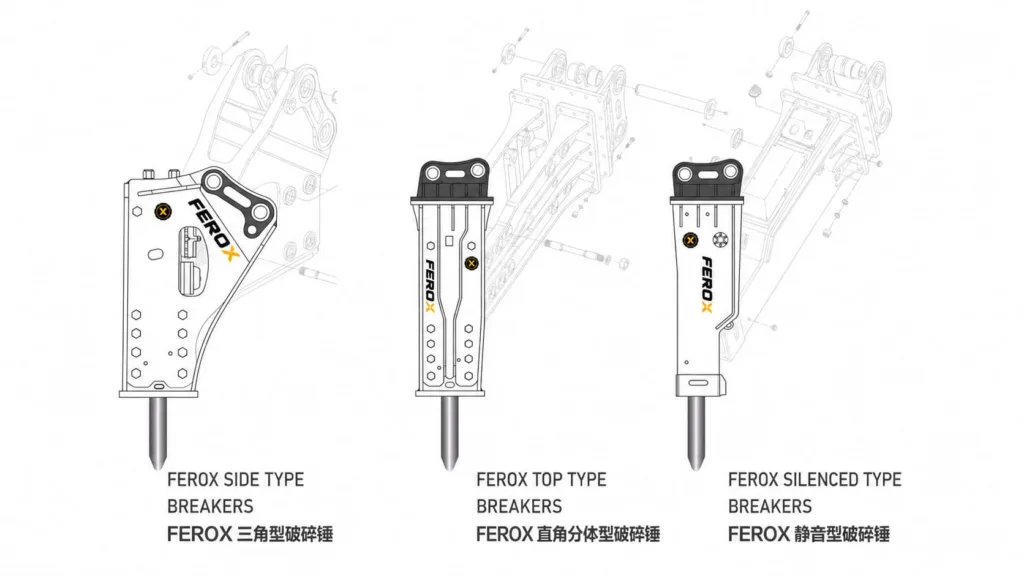
Hydraulic breaker types are not a performance ranking; there is no single best body style. Choose a silenced breaker for lower perceived noise and better power-cell protection, a side type (triangular) breaker for a compact open structure and convenient inspection, or a top type (right-angle) breaker for direct downward work and added reach. The excavator, hydraulic settings, application, and total attachment weight still determine the final model.
Silenced, side type, and top type hydraulic breakers may use a similar internal power cell, but their housings and mounting geometry change how the attachment fits, feels, and performs on a jobsite. Buyers should compare more than appearance or price. Visibility, working angle, noise control, maintenance access, carrier stability, and local service conditions all matter.
Silenced vs side type vs top type hydraulic breakers
| Selection point | Silenced / box type | Side type / triangular | Top type / right-angle |
|---|---|---|---|
| Structure | Power cell enclosed by a protective outer housing with damping material | Open power cell supported by side plates in a compact triangular layout | Open power cell with the mounting bracket positioned above the rear head |
| Main advantage | Lower perceived noise, reduced vibration transfer, and better protection from debris | Simple structure, direct inspection access, and a compact profile | Direct alignment for downward breaking and useful reach into trenches or foundations |
| Typical applications | Urban demolition, municipal work, rental fleets, and noise-sensitive projects | General construction, roadwork, mixed-angle breaking, and dealer stock | Trenching, foundation excavation, quarry work, and vertical breaking |
| Trade-off | Usually heavier and larger; housing removal may add service time | More operating noise and less protection around the power cell | Taller overall geometry and an exposed power cell; fit must be checked carefully |
| Best first question | Does the site require measured noise control or extra housing protection? | Does the buyer value simple access and a familiar, economical layout? | Is most work vertical or below grade? |
The table is a practical starting point, not a substitute for model matching. Two breakers in the same body style can have different operating weights, oil-flow ranges, working pressures, tool diameters, and impact characteristics.
What is a silenced hydraulic breaker?
A silenced hydraulic breaker, also called a box type or enclosed breaker, places the power cell inside a steel housing. Internal pads and the outer shell help reduce the noise and vibration transmitted through the housing while shielding the breaker body from dust, flying material, and accidental contact.
When a silenced breaker is the better choice
- Urban or municipal work: the enclosed design helps lower perceived operating noise near homes, offices, schools, and hospitals.
- Rental fleets: the housing provides an extra physical barrier around the power cell when operator experience varies.
- Dusty demolition: the outer shell offers better protection from debris, although routine cleaning and inspection are still required.
- Premium fleet positioning: many buyers prefer the clean, enclosed appearance and reduced vibration transfer.
"Silenced" does not mean silent, and the name alone does not prove compliance with a local noise limit. Ask for model-specific sound data, the measurement standard, test conditions, and the complete working configuration if the project has a contractual decibel requirement.
What is a side type or triangular hydraulic breaker?
A side type breaker uses two side plates to support the power cell and connect it to the excavator. The open, triangular arrangement is widely recognized in export markets and keeps routine inspection points accessible. Its relatively simple construction also makes it a practical option for dealers serving mixed construction customers.
When a side type breaker is the better choice
- General construction: it suits concrete, asphalt, roadwork, trench preparation, and secondary breaking where noise restrictions are limited.
- Frequent visual inspection: the open body makes hoses, fasteners, the front head, and other service areas easier to observe.
- Mixed working angles: the compact layout can help positioning and tool visibility, depending on the bracket and carrier.
- Dealer inventory: the familiar structure and competitive acquisition cost often fit price-sensitive, general-purpose demand.
The open design exposes more of the breaker body to dust and impact. Side-plate bolts and mounting hardware must be checked at the intervals specified in the manufacturer's manual. Buyers working in cities should also compare actual sound data rather than assuming a side type unit will be accepted on every site.
What is a top type or right-angle hydraulic breaker?
A top type breaker positions the mounting bracket above the rear head, producing the straight or right-angle profile familiar in many markets. This geometry is often selected for downward breaking because the breaker, stick, and working direction can be aligned directly. The longer profile may also help the tool reach below grade.
When a top type breaker is the better choice
- Trenching and foundation work: the layout is well suited to repeated vertical blows into rock, concrete, or hard ground.
- Quarry and secondary breaking: operators can position the tool over boulders or bench material for direct downward impact.
- Below-grade reach: the mounting geometry can be useful when breaking at the bottom of a trench or excavation.
- Buyers familiar with a straight profile: local operator preference and existing bracket standards can make top type models easier to sell and support.
A top type body does not automatically produce more impact energy than a side or silenced body. The power-cell design, hydraulic input, tool size, carrier setup, and material determine breaking performance. Confirm the complete attachment height and working weight so the carrier remains stable throughout its operating envelope.
Which breaker body type fits each application?
| Application or buying priority | Recommended starting point | Reason |
|---|---|---|
| City demolition or road repair near occupied buildings | Silenced / box type | Lower perceived noise and better housing protection |
| Rental fleet with different operators | Silenced / box type | Enclosed body protects the power cell from routine external contact |
| General dealer stock for mixed construction | Side type / triangular | Familiar structure, accessible inspection points, and broad demand |
| Deep trench or repeated vertical breaking | Top type / right-angle | Direct downward alignment and useful below-grade reach |
| Strict project noise specification | Silenced model with verified test data | The housing name is not enough; measured data is required |
| Lowest service complexity in a remote market | Side type, subject to application | Open access can simplify inspection, but spare-parts support remains essential |
Six checks before ordering any hydraulic breaker
- Confirm the carrier. Send the excavator brand, exact model, operating weight, arm configuration, and coupler details. Do not match only by a broad tonnage label.
- Verify hydraulic compatibility. Compare the carrier's available oil flow, working pressure, and relief setting with the breaker's approved range.
- Define the application. State the material, typical piece size, working angle, daily operating hours, climate, dust level, and any underwater or tunnel requirement.
- Check total working weight. Include the breaker, bracket, working tool, hoses, coupler, and accessories when assessing lift capacity and stability.
- Approve the mounting interface. Confirm pin diameter, pin-center distance, dipper width, hose size, and port position before production.
- Plan service support. Agree on working tools, seal kits, bushings, diaphragms where applicable, fasteners, warranty terms, manuals, and replenishment lead time.
What should a hydraulic breaker dealer stock?
Dealers should base the mix on local projects rather than ordering equal quantities of all three designs. A market dominated by municipal and rental work may justify more silenced units. General construction markets often begin with side type breakers. Quarry, trenching, and foundation customers may create stronger demand for top type models.
Keep the internal model family consistent where possible. Shared seal kits, bushings, working tools, and service procedures reduce inventory complexity. Before placing a mixed order, ask whether the three housing styles use the same power cell and which parts are truly interchangeable. Similar model names do not guarantee identical components.
Frequently asked questions
Which hydraulic breaker type is the quietest?
A silenced or box type breaker is normally the quietest of the three because its power cell is enclosed and isolated with damping material. Actual sound output varies by model, tool, carrier, material, operating method, and measurement distance. Use verified model data for regulated jobsites.
Which body type is easiest to maintain?
A side type breaker often provides the most direct visual and service access because the power cell is not surrounded by a full box housing. Maintenance time still depends on component design, fastener condition, tool-retainer access, parts availability, and technician experience.
Is a top type breaker more powerful?
Not automatically. A top mounting arrangement can support direct force alignment during vertical work, but impact performance comes mainly from the power cell and correct hydraulic input. Compare approved oil flow, pressure, impact rate, tool diameter, operating weight, and application test results.
Can the same breaker power cell use different housings?
Some manufacturers offer side, top, and silenced versions around a common power cell. Do not assume every housing can be swapped. The bracket, damping system, hose routing, total weight, fasteners, and product approval must match the manufacturer's design.
What information should I send for model matching?
Send the excavator brand and model, carrier operating weight, available oil flow, working pressure, application, required working tool, quantity, destination country, and any noise restriction. Photos of the arm end, coupler, and hydraulic lines can help confirm the installation.
Technical reference note
This guide follows the same core selection principles used by major equipment manufacturers: match the attachment to the carrier, verify hydraulic flow and pressure, define the job, and follow the model-specific operating manual. See Caterpillar's hydraulic hammer selection guide and Epiroc's hydraulic breaker selection overview. Manufacturer specifications and the carrier manual take priority over general guidance.