Hydraulic Breaker Operation & Maintenance Guide
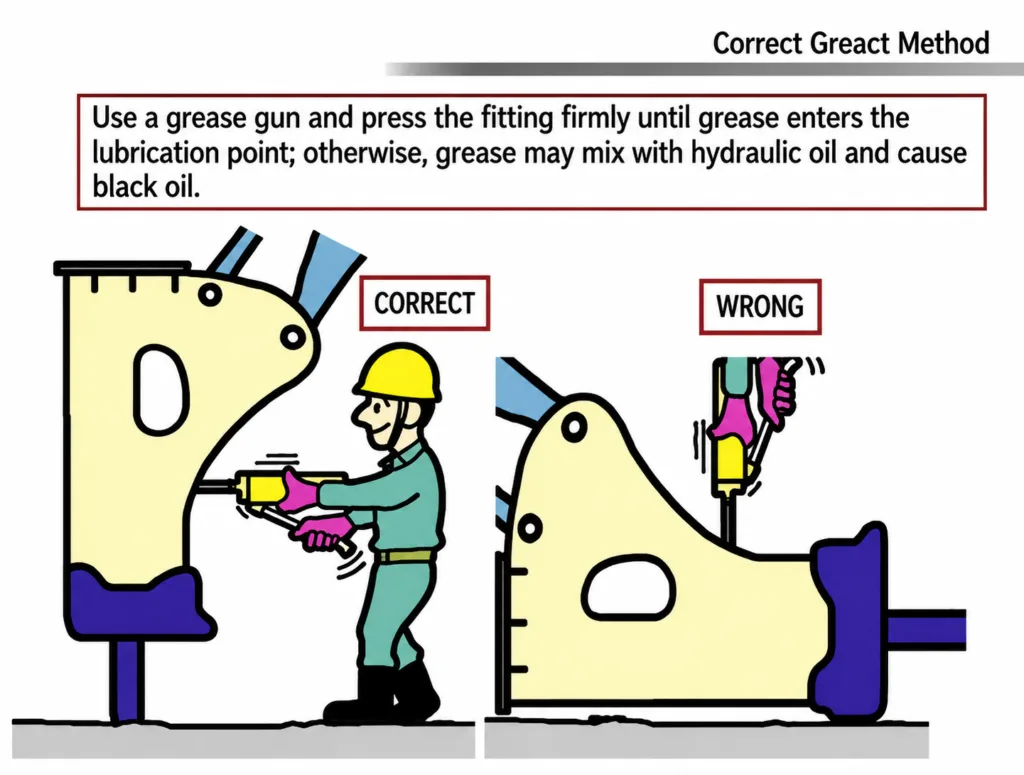
Hydraulic breaker operation and maintenance are model-specific. Before operation, storage, lubrication or repair, confirm the procedure in the approved manual for the exact breaker and carrier combination. Hydraulic flow, pressure, nitrogen-chamber handling, grease points, tool position and underwater limits can vary. Use this guide as a practical checklist, not as a substitute for those specifications.
.jpg)
Hydraulic Breaker Operation & Maintenance Checklist
- Before work: confirm carrier compatibility and model-specific hydraulic requirements; inspect the breaker, tool, hoses, pins and retainers.
- During daily checks: look for leaks, cracks, loose hardware and abnormal wear; lubricate only at the specified points with the recommended grease.
- While operating: keep the tool aligned as instructed, avoid prying and blank firing, and reposition when the material does not break within the manual’s stated interval.
- Before long storage: clean and protect the attachment, follow the specified storage position, and leave accumulator or nitrogen work to the procedure and trained personnel.
- For underwater work: use only an approved underwater configuration with its model-specific air, carrier and depth requirements.
1. Confirm the Breaker and Carrier Setup
A breaker depends on the carrier’s hydraulic circuit. Before fitting or operating an attachment, check the approved manuals for the compatible carrier class, oil flow, operating pressure, return-line or back-pressure limits, hose connections and mounting hardware. Do not use a setting copied from another breaker, excavator or job site. If the machine’s specifications are unclear, confirm them with the equipment supplier before starting. For carrier selection steps, see our hydraulic breaker selection guide.
Park on stable ground, secure the machine as directed by the carrier manual and keep people outside the work area. Before inspecting or servicing the attachment, shut down and isolate the equipment using the prescribed procedure; hydraulic lines and accumulators can retain hazardous energy.
2. Perform a Daily Pre-Operation Inspection
Make a visual check before each shift and after unusual impact or transport. Look for hydraulic leaks, damaged hoses, cracks, loose or missing fasteners, worn tool bushings, damaged retainers and a tool that does not move or seat normally. Check that protective caps are removed only when connecting the attachment and that couplers are clean. Never search for a pressurized leak with your hand.
Stop and resolve a leak, loose connection, cracked part or abnormal noise before continuing. Inspection intervals and wear limits vary, so use the dimensions and replacement criteria in the manual for your model rather than judging by appearance alone.
3. Lubricate the Tool the Way Your Model Requires
Use the specified chisel paste or grease, at the listed lubrication points and interval. The required quantity and method depend on the breaker design and whether it has an automatic lubrication system. More grease is not automatically better: excess or incorrectly placed grease can interfere with operation or contaminate nearby areas.
Some manufacturer procedures require the working tool to be pressed into its operating position before manual greasing. For example, Epiroc’s maintenance instructions describe a model-specific tool position and lubrication method. Follow the instructions for your own breaker model; do not treat another manufacturer’s steps as universal.
4. Store the Breaker and Return It to Service Safely
For storage, clean the attachment, protect exposed ports and metal surfaces, and choose the storage position specified by the manufacturer. Keep it in a dry, secure area where it cannot be struck or contaminated. Before restarting after storage, inspect the tool, retainers, hoses and connections, then complete any checks required by the manual.
Do not automatically release nitrogen or accumulator pressure for storage. The correct procedure can differ by model, storage position and duration. For instance, published Epiroc and MTB manuals give different model-specific storage procedures. Depressurization or charging must follow the exact manufacturer instructions and be performed by qualified personnel with the required equipment. If service work has opened the hydraulic circuit or changed accumulator pressure, use the model’s commissioning procedure before operation.
5. Use Operating Practices That Reduce Wear
- Keep the tool in the working position and alignment specified by the manual; avoid using it as a pry bar.
- Do not operate the breaker without firm tool contact or continue striking after the material has broken.
- If the material does not yield, stop and reposition instead of holding the tool on one point indefinitely.
- Observe the maximum continuous striking interval for the exact model. There is no safe universal time limit; Caterpillar’s operating guidance also stresses repositioning and stopping when material breaks.
- Watch for changes in sound, impact, oil temperature or performance. Stop if the breaker or carrier exceeds its stated limits, then inspect before resuming.
For additional examples of operating and positioning practices, see Caterpillar’s excavator hammer operating tips. Its recommendations apply to the equipment covered by that guidance; your breaker’s manual takes precedence.
6. Treat Special Job Conditions as Separate Setups
Overhead or dusty work
Use only the dust protection or accessories approved for your breaker. Do not improvise a cover around the chisel if it could restrict tool movement, retain heat or interfere with the retainer. Follow the manufacturer’s inspection and cleaning instructions for dusty work.
Underwater operation
Do not submerge a standard breaker based on a generic depth rule. Underwater use may require a dedicated breaker configuration, an air supply and a compatible carrier setup; allowable depth and airflow are model-specific. Epiroc’s underwater operation instructions illustrate why the setup must be confirmed for the exact model. Contact FEROX support if you cannot verify your breaker’s approved configuration.
Frequently Asked Questions
How often should I grease a hydraulic breaker?
Use the interval, lubricant and quantity specified for your exact model. Manual greasing schedules are not interchangeable between breaker designs, and automatic lubrication systems have their own checks.
Should I release nitrogen before storing a breaker?
Not unless the exact model’s storage procedure requires it. Nitrogen accumulator work can be hazardous and should be completed only by qualified personnel using the manufacturer’s instructions.
Can I use a hydraulic breaker underwater?
Only if the breaker and carrier are approved for the required underwater configuration and the manual’s depth and air-supply conditions are met. A generic rule based on the visible bushing or water depth is not reliable.
How long can a breaker strike continuously?
Follow the maximum interval stated in the model-specific manual. If the material does not break within that interval, stop, reposition and check the operating setup.
Manufacturer References
- Epiroc hydraulic breaker maintenance instructions
- Epiroc underwater operation instructions
- Caterpillar excavator hammer operating tips
- MTB 95 operation manual (storage example)
These external manuals are cited to show why procedures differ between models. They are not FEROX instructions. Always follow the approved manual for your specific breaker and carrier.