Hydraulic Breaker Piston: Black PVD vs. Standard Finish
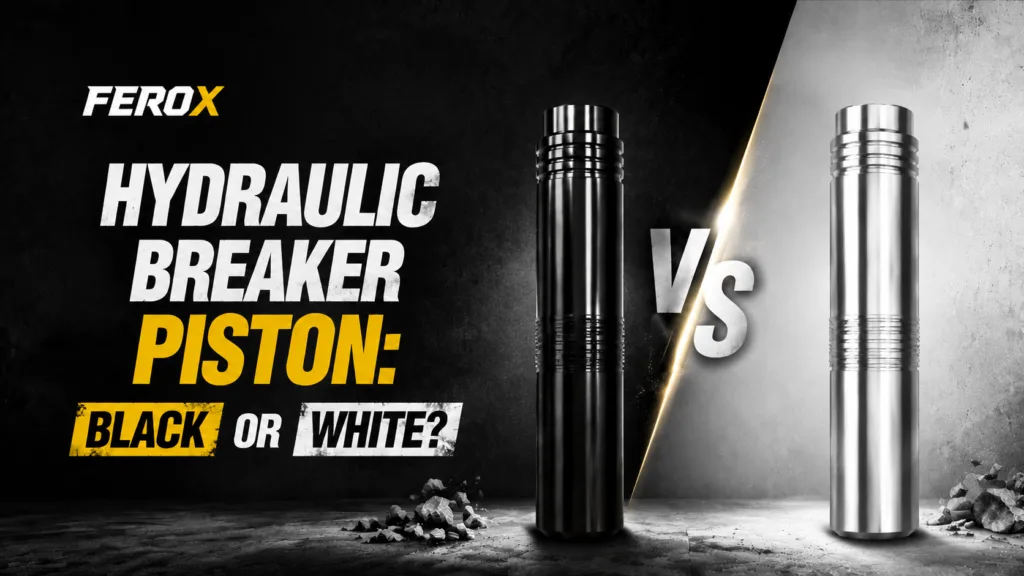
Short answer
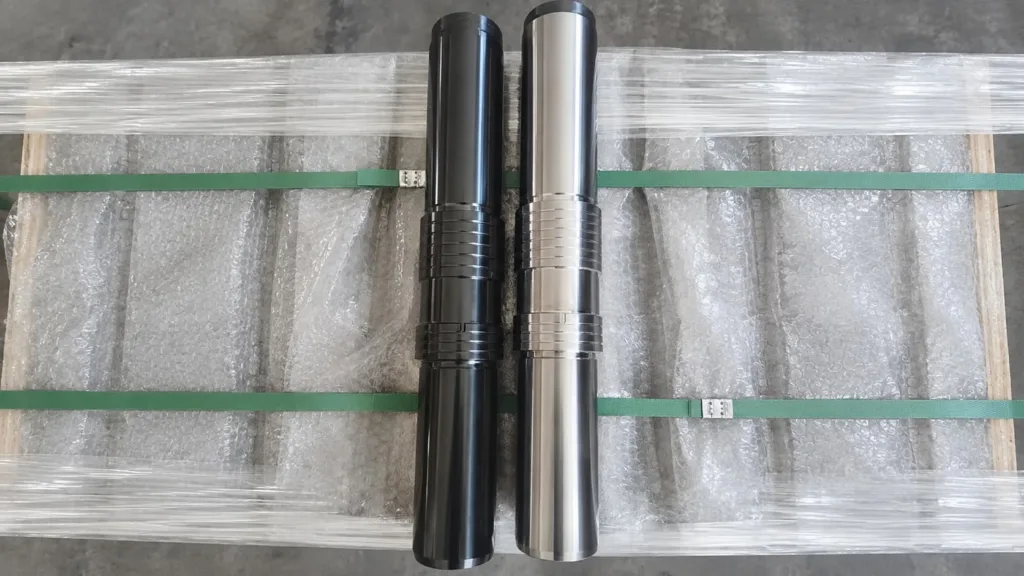
A hydraulic breaker piston that looks black is not automatically PVD-coated, and a bright or “white” piston is not automatically untreated or lower quality. Color shows the finish you see; it does not prove coating chemistry, hardness, fit, or service life. Ask for process records and model-specific evidence before comparing.
Black PVD vs. standard-finish piston: quick comparison
| What you see | What appearance alone tells you | What to verify |
|---|---|---|
| Black piston | Only that the visible surface is black | Coating or treatment name, process, specification and traceability |
| Bright or “white” piston | Only that the surface has a bright finish | Base material, heat treatment and any surface treatment |
| Black layer with unknown process | It may be PVD or another finish | Written process declaration and relevant test records |
What does PVD mean on a hydraulic breaker piston?
PVD stands for physical vapor deposition, a family of processes that forms a thin film by depositing material in a vacuum. PVD is a process category, not one universal coating recipe. Coating composition and structure, the piston substrate, surface preparation, process controls and service conditions all affect the finished part.
Some PVD coating systems are designed to improve properties such as hardness or wear resistance, but those general possibilities do not establish the performance of a particular breaker piston. Oerlikon Balzers explains how PVD coating properties can be tailored to the coating system and application in its overview of coatings for precision components. It is general coating information, not a test report for a FEROX piston.
Why color is not enough to compare piston quality
A black finish may come from PVD, another deposited coating, a conversion treatment, paint or a different surface process. A bright or “white” appearance may describe a polished or standard finish; it does not tell you whether the steel was heat-treated or otherwise processed. These labels are often informal, so ask the supplier to name the actual process in writing.
Likewise, a coating name by itself does not establish longer service life. Hydraulic breaker piston life also depends on correct part fit, operating conditions, lubrication, oil cleanliness, maintenance and the condition of the breaker. Avoid comparing a coating claim unless the parts and test conditions are comparable.
What to request before buying a replacement piston
| Check | Ask the supplier for | Why it matters |
|---|---|---|
| Part identity | Exact part number, breaker make and model, and compatibility confirmation | Prevents a finish comparison from distracting from fit |
| Dimensions and finish | Dimensioned drawing, tolerances, surface finish and critical clearances | Coating and machining must preserve the required fit |
| Material and processing | Base material, heat-treatment specification and any surface-treatment declaration | Shows what the complete component is made and processed from |
| Coating details | Process name, coating material or specification, treated areas and thickness where applicable | Distinguishes a documented coating from a color description |
| Performance evidence | Test method, sample details, results and conditions for hardness, adhesion or wear claims | Makes supplier claims easier to compare fairly |
| After-sales support | Batch traceability, warranty terms, installation instructions and failure-review process | Supports service and any later quality investigation |
How to compare black PVD and bright-finish pistons
- Confirm the exact fit first. Match the piston to the breaker model and part number, and verify critical dimensions and clearances.
- Identify the surface process. Request the treatment name and supporting records; do not infer PVD from a black appearance.
- Compare like with like. If hardness, adhesion or wear performance is claimed, request the test method, substrate, sample size and conditions. A result from a different material or test setup may not predict service in your breaker.
- Check the complete part specification. Review base material, heat treatment, machining and coated areas together. A coating cannot compensate for incorrect geometry or an unsuitable component.
- Consider operating cost only with evidence. Compare purchase price, warranty and documented field or test data for equivalent breaker models and applications. Do not assume a color or process label guarantees a longer interval between replacements.
Common questions
Does a black hydraulic breaker piston mean it has a PVD coating?
No. Black color alone cannot identify the process. Ask the supplier for the named coating or treatment and traceable documentation for the part or production batch.
Does PVD automatically make a piston last longer?
No universal service-life result follows from the term PVD. The outcome depends on the coating system, piston substrate and processing, correct fit, breaker condition, application and maintenance. Request relevant, comparable test or field evidence.
Is a bright or “white” piston lower quality?
Not based on color alone. A bright finish does not identify the base material, heat treatment, tolerances or quality controls. Compare the complete specification and documented quality checks.
Can coating thickness affect piston fit?
It can affect dimensions wherever coating is applied. Ask how critical dimensions and clearances are controlled after processing, and confirm the finished component meets the breaker manufacturer’s requirements.
What is the safest way to choose a replacement piston?
Start with the exact breaker model and part number. Confirm dimensions, material, processing, surface-treatment details, traceability and warranty before ordering. Follow the breaker manufacturer’s repair and installation instructions.
Related guidance
For attachment matching and hydraulic requirements, see our hydraulic breaker selection guide. For inspection and service procedures, follow the exact model manual and see our operation and maintenance guide. If you need help confirming a replacement part, contact the FEROX team with the breaker model and part number.